
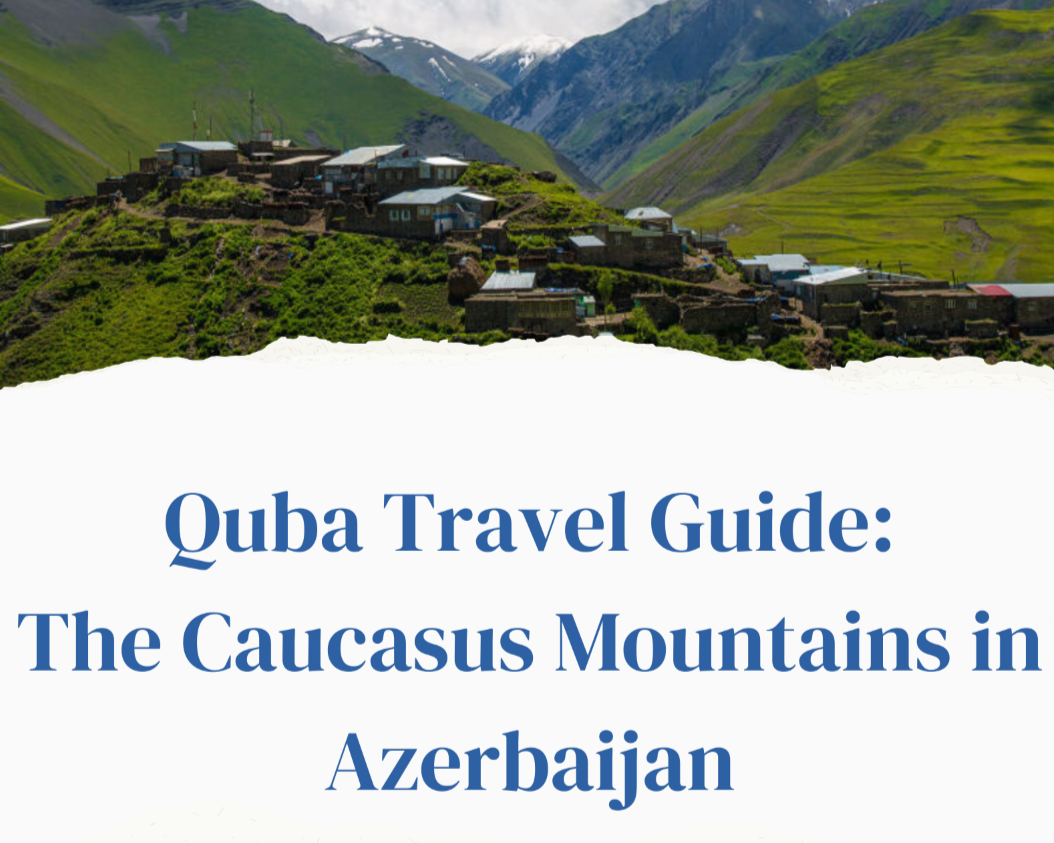
Most visitors to Azerbaijan begin and end in Baku – and while the capital is genuinely extraordinary, it is only one side of the country. Drive three hours north and the landscape transforms completely: apple orchards replace desert, mountain rivers cut through deep gorges, and stone villages perch at altitudes where clouds pass below you at eye level.
The Quba region is Azerbaijan’s gateway to the Greater Caucasus – a world of waterfalls, ancient villages, ski resorts, and one of the most remarkable UNESCO-listed settlements in the entire Caucasus range. This Quba Azerbaijan Travel Guide covers everything you need to plan a trip from Baku to Quba and beyond.
Explore the Caucasus with our full Azerbaijan and Caucasus tours for inspiration.
Quba: The Gateway to the Caucasus Mountains
Quba (also spelled Guba) is a tiny settlement of around 23,000 people in northeastern Azerbaijan, located at the foot of the Greater Caucasus approximately 170 kilometers north of Baku. It’s also known as the “City of Apple Trees” because the surrounding slopes and valleys are packed with orchards, and it has a very different ambiance than Baku: calmer, greener, and colder even in the summer.
Quba is primarily known as a base for the mountains above it, but the town itself has several attractions worth visiting before heading uphill.
Juma Mosque
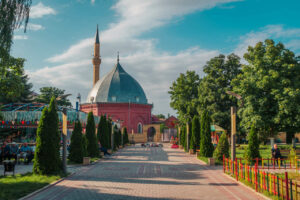
The Juma Mosque, a 19th-century structure with intricate brick patterns and beautiful wooden features typical of the Quba-Khachmaz architectural style, is the city’s most iconic landmark. The inside is calm and large, with plenty of natural light streaming in through the tall windows. Non-Muslim guests are welcome outside of prayer times.
Red Town (Krasnaya Sloboda) in Quba Azerbaijan
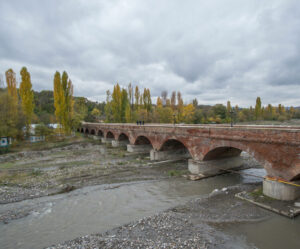
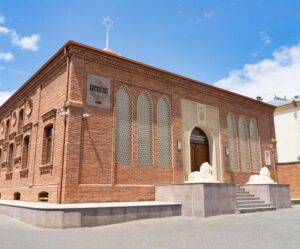
Cross the Gudialchay River on the 19th-century arch bridge, Azerbaijan’s longest remaining red-brick arch bridge at 275 meters, and you’ll arrive in one of the most peculiar settlements in the Caucasus. Krasnaya Sloboda, or “Red Town,” is home to the Mountain Jews (Dag Chufut), a population that has preserved traditional Jewish traditions in Azerbaijan for centuries after migrating from northern Iran during the Sassanid Empire era.
The community speaks a separate language known as Juuri. The area is divided into nine independent districts, each with its own synagogue. It is thought to be the only all-Jewish town in the world outside Israel and the United States, and it is a truly wonderful site to walk through silently and respectfully.
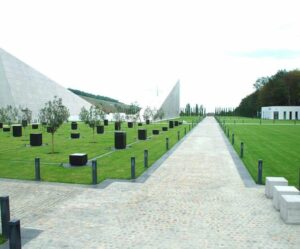
Quba Genocide Memorial Complex
A sobering and historically significant site on the banks of the Gudialchay River, the memorial commemorates the thousands of civilians killed in the 1918 massacres during the post-WWI period. The complex is thoughtfully designed and offers important context for understanding Azerbaijan’s 20th-century history.
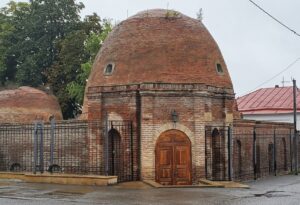
Chuhur Hamam
An 18th-century bathhouse in the old part of Quba, representing one of the last surviving examples of traditional Azerbaijani bathhouse architecture in the region. Worth a stop on a walking tour of the historic center.
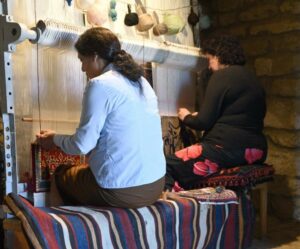
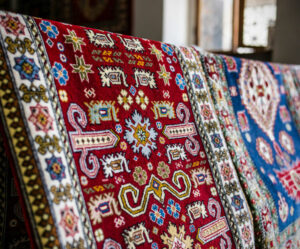
Carpet Weaving
Quba is a historic carpet-making center in Azerbaijan, known for its unusual rugs with geometric patterns and deep reds. Several workshops in the area encourage visitors to observe the weaving process, and purchasing directly from an artisan here is one of the nicest souvenirs you can bring back from Azerbaijan.
| 📍 Quba Azerbaijan Practical Info
Distance from Baku: ~170 km (approx. 2.5-3 hours by car) Best combined with: Khinalug village, Afurja Waterfall, Shahdag Resort Best time to visit: May-June (wildflowers) or September-October (foliage, harvest) Local food to try: piti (slow-cooked lamb stew), local honey from Qechresh market Getting there: by car (recommended), or bus/shared taxi from Baku’s Avtovagzal bus station |
Khinalug: One of the Oldest and Highest Villages in the World
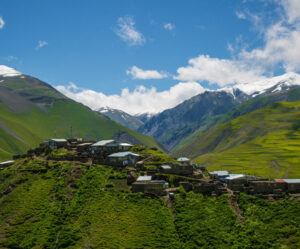
A town located 57 kilometers from Quba, along a winding mountain road that climbs through stunning gorges and alpine meadows, catches the attention of most visitors. Khinalug (also called Khinalig or Xinaliq) is located at roughly 2,350 meters above sea level in the heart of the Greater Caucasus, making it one of Europe’s highest continuously inhabited settlements, surpassing even Ushguli in Georgia in altitude.
The settlement has been inhabited for more than 5,000 years. It is flanked on all sides by peaks that are higher than 4,000 meters: Bazarduzu (4,466 meters), Shahdag (4,243 meters), and Gizilgaya. Clouds frequently pass below the village, at eye level. Winter temperatures dip to -20°C. In the summer, flowery meadows extend to the horizon.
The Khinalug People & Their Language
What makes Khinalug truly extraordinary is not just its setting but its people. The roughly 2,000 residents of Khinalug are a distinct ethnic group – the Khinalug people, who call themselves the “Kettid” and their village “Kyat.” They speak a language called Ketsh (or Khinalug), a linguistic isolate within the Northeast Caucasian language family spoken by only a few thousand people worldwide and recognized by UNESCO as endangered.
The language has survived because the village’s extreme isolation protected it for centuries from the outside world. Khinalug was almost entirely self-sufficient until the modern road was built, growing what little could be grown at altitude – potatoes, cabbage, wheat – and relying on livestock for everything else.
UNESCO World Heritage Status
Khinalug and the Köç Yolu Transhumance Route were designated as UNESCO World Heritage sites in September 2023. The classification includes the village itself, the surrounding highland meadows, the winter lowlands used by the community’s herds, and the 200-kilometer seasonal migration route that the Khinalug people have used for centuries to transport their sheep between summer mountain pastures and winter plains. This ancient practice – called transhumance – continues today.
Architecture
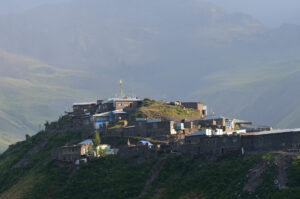
The houses of Khinalug are built from local stone on the steep mountain slopes, stacked so closely together that the roof of one house serves as the courtyard of the next house above it. Walking through the village feels like ascending a tiered fortress. The buildings are 200-300 years old; ruins of older structures surround the settlement. There is no wasted space and no straight lines – the village grows organically with the mountain.
Zoroastrian Fire Temple (Ateshgah)
About 5km from the village, at an altitude of around 3,000 meters, lies Khinalug’s Ateshgah – a Zoroastrian fire temple where natural eternal flames burn from the ground, fueled by underground methane gas deposits. Before the village converted to Islam following Arab conquests in the 7th-8th centuries, the Khinalug people were Zoroastrians, and fire worship was central to their culture. The flame is still burning. Locals who visit the site for reasons other than prayer occasionally cook kebabs straight on the warm rocks, creating a striking contrast of the ancient and the everyday.
Hiking Around Khinalug
- Khinalug to Galakhudat – a popular trail offers breathtaking views of the Gudyalchay valley and Mount Gizilgaya, making it ideal for fit trekkers.
- Khinalug to Laza – a longer, more demanding trail connecting two remote villages through high alpine terrain; for experienced trekkers only.
- Village walking circuit – even just wandering the lanes of Khinalug with no particular destination delivers extraordinary mountain views in every direction.
| 💡 Khinalug Visitor Tips
· The road from Quba takes about 1.5-2 hours by car – an SUV is strongly recommended · Altitude: some visitors experience mild headaches on arrival; rest and hydrate · Homestays are available in the village; staying overnight gives a completely different experience to a day trip · Guides from Quba can arrange tours – hiring one is helpful as very few signs are in English · Best visited from May to October; the road can be difficult or closed in winter due to snow · Respect local customs – the community is conservative and deeply religious |
Nature & Outdoor Attractions Around Quba
Afurja Waterfall
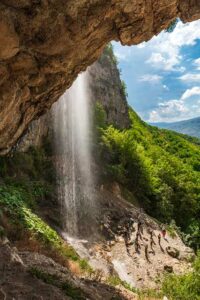
The tallest waterfall in Azerbaijan, dropping around 50 meters into a rocky gorge surrounded by dense forest. The approach takes you down a magnificent canyon road with walls reaching 600 meters on either side – one of the most stunning drives in the country. There are small cafes near the waterfall where you can enjoy tea and local sweets while listening to the waterfall.
Qechresh Forest
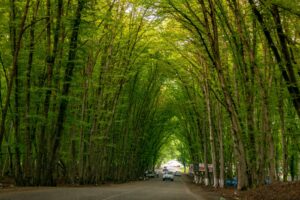
A lovely beech and oak forest just outside Quba town, ideal for picnics, easy walks, and a true getaway from the heat of the lowlands. Several resorts and guesthouses are located within the forest, making it an excellent overnight destination if you want something quieter than Quba town itself. The nearby Qechresh Bazaar is a great spot to acquire local honey, as the Quba region is famed for its unique mountain honey variations.
Gigilchay Fortress & Chirag-Kala Tower
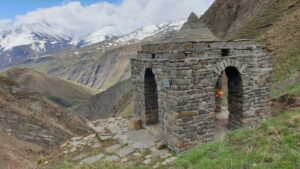
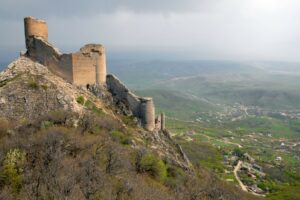
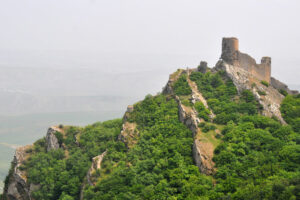
A 50-kilometer-long defense wall built in ancient times to protect the South Caucasus from northern invaders – essentially Azerbaijan’s equivalent of Hadrian’s Wall. The highlight is the Chirag-Kala Tower (“lamp tower”), which was built on a cliff to transmit fire signals as enemies approached. The journey to the top is challenging, but the view over the mountains is breathtaking.
Shahdag Mountain Resort
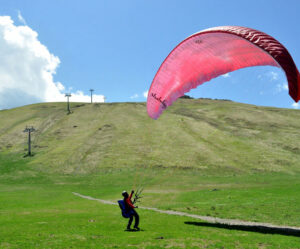
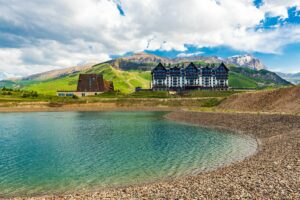
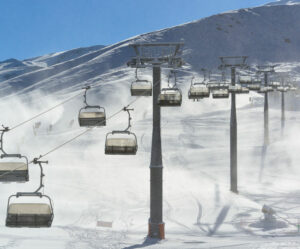
Azerbaijan’s largest ski resort is located in the Greater Caucasus, above Quba. From December to March, Shahdag provides varied-complexity ski runs, while in the summer it converts into a hiking and outdoor recreation destination. The resort includes hotels, restaurants, and a zip line, and the cable car allows non-skiers to enjoy high-altitude vistas without exerting effort.
The Candy Cane Mountain: Azerbaijan’s Viral Landscape
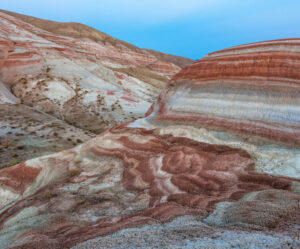
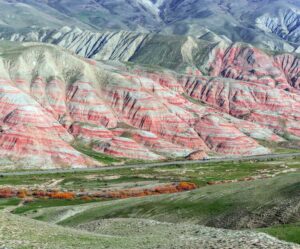
Between Quba and Khinalug, near a bend in the mountain road, stands one of Azerbaijan’s most photographed natural formations: a hillside with sharply striped red and white clay bands produced by mineral deposits over geological time. The distinctive horizontal stripes gained it the nickname “Candy Cane Mountain” among international visitors, and it has since become one of the most popular photographs of Azerbaijan on social media.
The structure is visible from the road and can be photographed without a long trip. It works nicely as a stop on the Quba-Khinalug Road, and the contrast between the vibrant red-and-white dirt and the green mountains surrounding it is truly breathtaking.
Suggested Itinerary: Quba & the Mountains
Day 1 – Baku to Quba
- Depart Baku in the morning by car (~3 hours)
- Arrive Quba – walk the historic center, visit Juma Mosque
- Cross the arch bridge to Krasnaya Sloboda and explore the Mountain Jewish quarter
- Afternoon: Qechresh Forest walk and Qechresh Bazaar (honey tasting)
- Overnight in Quba town
Day 2 – Quba to Khinalug
- Early start for the drive to Khinalug (1.5-2 hours, SUV required)
- Stop at Candy Cane Mountain for photos on the way up
- Arrive Khinalug – walk the village lanes, visit the ethnographic museum
- Optional: hike to the Ateshgah (fire temple) above the village
- Optional: overnight homestay in Khinalug (strongly recommended for the atmosphere)
Day 3 – Waterfalls & Return
- Morning: descend from Khinalug to the Afurja Waterfall (canyon road is spectacular)
- Afternoon: visit Gigilchay Fortress and Chirag-Kala Tower if energy allows
- Return to Baku or continue to Lahij/Sheki for a longer circuit
| 🚗 Why booking a tour is better
Public transport reaches Quba from Baku but stops there – getting to Khinalug independently requires a local taxi or tour With our tour (SUV recommended), you set your own pace and can stop at the Candy Cane formation, waterfalls, and viewpoints freely The Quba-Khinalug road is unpaved in sections – a standard sedan is possible in summer but an SUV gives genuine peace of mind The tour also opens up extensions: Lahij village, Sheki, or the Ismayilli wine region all become easy add-ons |
Quba vs Svaneti: How the Azerbaijani and Georgian Caucasus Compare
Travelers who’ve visited Svaneti in Georgia often ask how Quba and Khinalug compare. They are similar in many ways – high mountain villages, ancient communities, dramatic scenery, difficult access – but feel completely different in character.
- Svaneti has more dramatic tower architecture and a longer-established international hiking profile; Khinalug feels rawer and less visited
- Khinalug’s altitude (2,350m) exceeds Mestia’s (1,500m) and rivals Ushguli (2,200m)
- The Khinalug people’s linguistic and cultural uniqueness has no parallel in Svaneti – the Ketsh language is found nowhere else on earth
- While Svaneti has greater tourism infrastructure, Khinalug is more real due to its lack thereof.
- Ideally, visit both – they’re on the same mountain range, separated by a border, and complement each other beautifully
Combining Azerbaijan and Georgia in one trip? We specialize in exactly this. See our Caucasus multi-country tours for tailor-made itineraries.
Frequently Asked Questions
Do I need an SUV to drive to Khinalug?
An SUV is highly suggested, especially outside of the hot months. The route from Quba to Khinalug is mostly paved, but it becomes rougher in the final stretch. High ground clearance makes a big difference.
Is it possible to visit Khinalug as a day trip from Baku?
Technically yes – it’s around 220km from Baku to Khinalug by road, so a very long day trip is possible. In practice, it’s exhausting, and you miss the best of the experience. We recommend at least one night in Quba and ideally one night in Khinalug itself.
Is Krasnaya Sloboda safe and open to visitors?
Yes, the Mountain Jewish community of Krasnaya Sloboda welcomes respectful visitors. The synagogues and the community museum can be visited. Dress modestly, be quiet in places of worship, and approach the neighborhood as you would any conservative religious community – with respect and sensitivity.
What is the best time of year to visit Quba?
May to June is excellent for wildflowers and lush green landscapes. September to October offers golden foliage and the apple harvest. July and August are warm but can be very popular. Avoid winter (November–March) unless you’re specifically visiting Shahdag for skiing, as mountain roads can be closed or hazardous.
Can I combine Quba with Sheki?
Yes — and it makes an excellent 4-5 day itinerary. From Quba, head west along the mountain foothills to Lahij (a traditional coppersmith village) and then to Sheki, one of Azerbaijan’s most beautiful historic towns.
Plan Your Quba Azerbaijan & Caucasus Mountain Trip
The mountains north of Quba represent Azerbaijan at its most primal – ancient, dramatic, and relatively unknown to international tourists. Khinalug alone is worth the trip: a UNESCO World Heritage town whose inhabitants still speak a language found nowhere else on the planet, at an elevation where clouds glide by at eye level.
Whether you’re driving alone or taking a guided tour, this area of the Greater Caucasus should be on any serious Caucasus itinerary.
→ Explore Azerbaijan and Caucasus tours
→ Read our Azerbaijan Cuisine Guide
→ Contact us for a tailor-made Caucasus itinerary
About Caucasus Trip
Caucasus Trip is a family-run travel agency based in Tbilisi, Georgia, specializing in private tours, car rentals, and tailor-made experiences across Georgia, Armenia, and Azerbaijan.

Comment (0)