
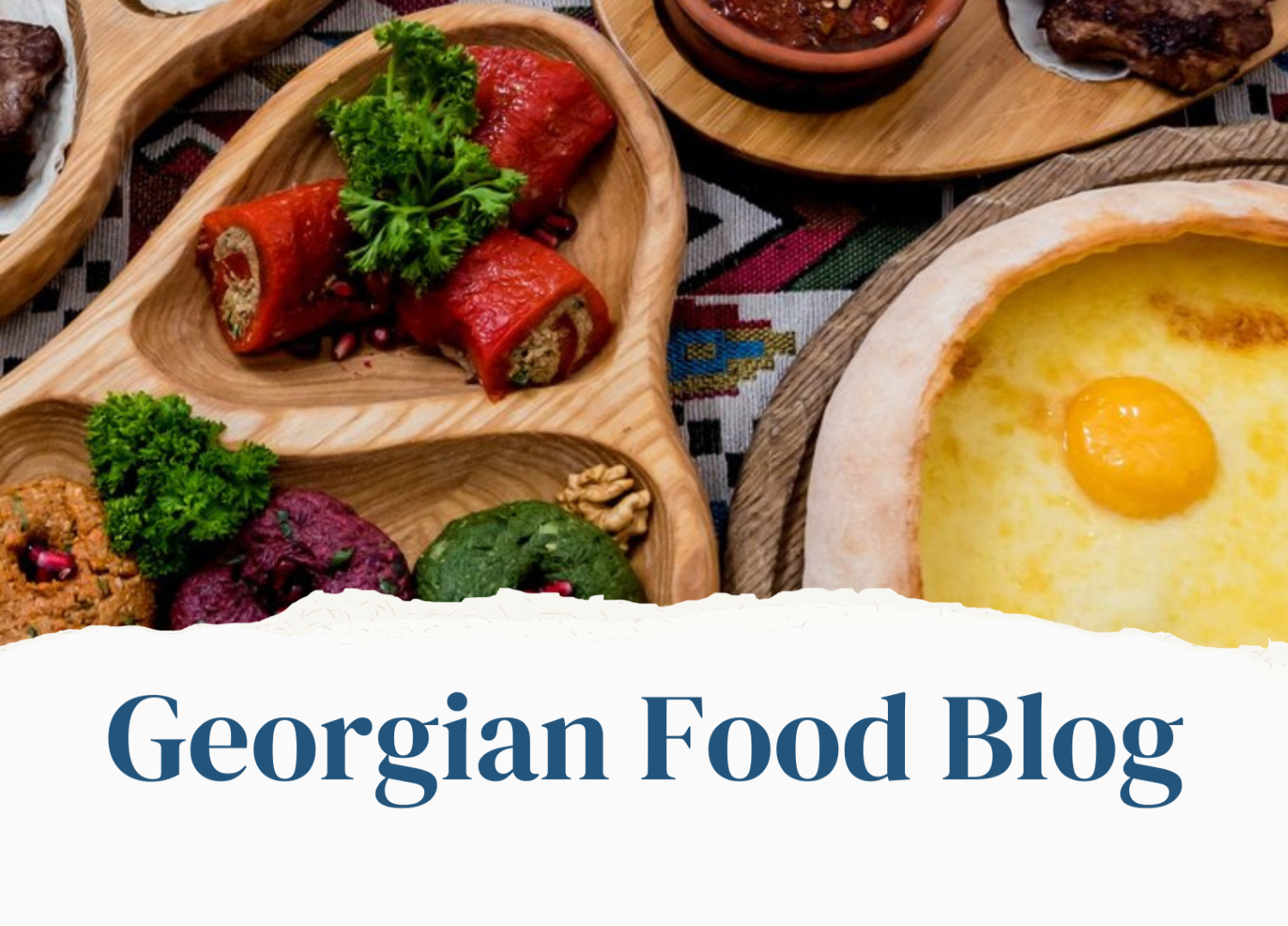
Georgian food is one of the great undiscovered cuisines of the world. Sitting at the crossroads of Europe and Asia, Georgia has developed a culinary tradition unlike anything else: rich walnut sauces, freshly baked bread pulled from clay ovens, cheese that melts into egg yolk, wine aged in clay vessels buried underground. It is food that tells the story of a country.
Georgians are just as proud of their cuisine as they are of their rich history and traditions. We will talk about supra, a traditional Georgian feast featuring a variety of local dishes and homemade wine, which demonstrates the importance of food in Georgian culture.
Whether you’re planning a trip to Tbilisi or already exploring the country, this Georgian food blog covers the 20 Georgian dishes every visitor should try, where to find them, and what makes each one special.
Planning a trip? Explore our Georgia tours or rent a car to discover the regions where these dishes come from: Car Rental Georgia.
Bread, Cheese & Khachapuri
No food is more central to Georgian identity than khachapuri – cheese-filled flatbread. Each region has its version of Khachapuri, which comes in different shapes and sizes.
Georgians eat it for breakfast, lunch, and dinner. There is no wrong time for khachapuri.
- Adjarian Khachapuri (Acharuli Khachapuri)
The most famous and most photogenic of all Georgian dishes. An Adjarian khachapuri is a boat-shaped bread filled with melted cheese, topped with a raw egg and a knob of butter, served bubbling hot straight from the oven. You stir the egg into the cheese, tear off strips of the bread crust, and dip. This dish alone is worth a trip to Georgia.
💡 Local tip: The best Adjarian Khachapuri is found in Batumi and western Georgia, where the dish originates.
- Imeruli Khachapuri (Imeruli Khachapuri)
The round, flat version from the Imereti region – thin layers of dough filled with a mix of fresh Imeruli cheese and suluguni, cooked in a pan or baked until golden. It’s simpler than the Adjarian version but arguably more satisfying for everyday eating.
💡 Local tip: This is the most commonly eaten Khachapuri in Georgia. Order it at any restaurant or traditional family eatery.
- Megruli Khachapuri (Megruli khachapuri)
A variant from the Samegrelo region – like the Imeruli but with extra cheese melted on top as well as inside. Twice the cheese. Beloved across the country.
💡 Local tip: Look for it in western Georgia and in Tbilisi restaurants that specialize in Megrelian cuisine.
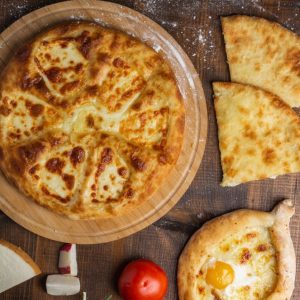
- Lobiani (Lobiani) – vegetarian
Similar to Khachapuri, there are several other stuffed bread variations in different regions of Georgia. Lobiani is a flatbread from the Racha region, filled with heavily spiced mashed kidney beans, often with additions of herbs. It’s hearty, warming, and particularly popular in the mountain regions. Think of it as the savory cousin of Khachapuri.
💡 Local tip: Lobiani is especially popular on St. Barbara’s Day in Georgia, but you’ll find it year-round in bakeries and traditional restaurants.
- Kubdari and Mkhlovani (Kubdari and Mhlovani)
A spiced meat-filled flatbread from Svaneti – the remote mountain region in northwestern Georgia. The filling is raw pork or beef, onion, and Svan spices (a unique blend used only in this region), folded into dough and baked. It’s heavier and more intensely spiced than other Georgian bread dishes.
Mkhlovani is another flatbread from the eastern mountainous region that is filled with spinach or beet leaves mixed with cheese and spices.
💡 Local tip: Kubdari is a Svanetian specialty – you’ll eat the best version in Mestia or Ushguli. If you’re planning a Svaneti trip, our car rental service makes getting there straightforward.

- Shotis Puri (Shotis Puri)
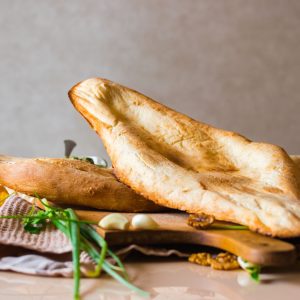
The long, canoe-shaped flatbread is baked on the inner walls of a tone (clay oven). This is the everyday bread of Georgia – crispy on the outside, soft inside, eaten fresh within hours of baking. Walk past any bakery in Tbilisi in the morning, and you’ll smell it from the street.
💡 Local tip: Buy it still warm from a tone bakery. Eat it plain, tear it with cheese or butter. It needs nothing else.
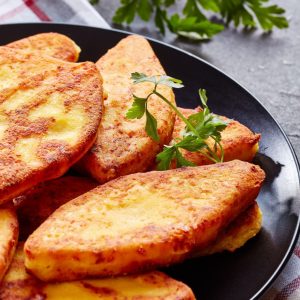
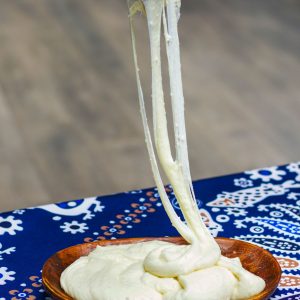
As an alternative to bread, people in different regions of Georgia also widely consume cornbread, known as Mchadi, and a cornmeal porridge called Ghomi. Both dishes have cheese-enriched variations: Chvishtari (Mchadi with melted cheese) and Elarji (Ghomi with melted cheese).
Dumplings, Main Dishes & Hearty Stews
- Khinkali (Khinkali)
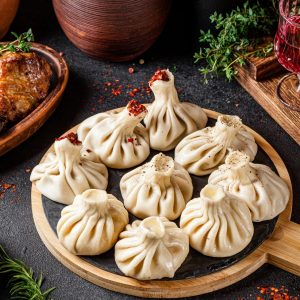
Georgia’s iconic dumplings are made from thick dough twisted into a knot around a filling of spiced meat with broth. The traditional filling is pork and beef mince, but they can also be filled with mushrooms, potatoes, or cheese. The correct technique is to hold the knot (the “tail”), take a small bite, suck out the hot juice inside, and then eat the rest. The knot is traditionally left on the plate.
💡 Local tip: The best khinkali come from the mountain villages of Kazbegi and Mtiuleti, where they originate. In Tbilisi, Pasanauri restaurant, Pictograma, or Zodiaqo. Count your dumplings – locals often eat 10 or more.
Vegetarian Khinkali is made with mushrooms, potatoes, or cheese.
- Chakapuli (Chakapuli)
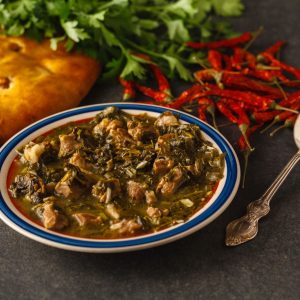
Spring lamb stew made with fresh tarragon, tkemali (sour plum sauce), white wine, green onions, and other herbs. It’s bright, herby, and completely unlike any stew you’ve tried elsewhere. Chakapuli is traditionally eaten at Easter but appears on menus throughout spring.
💡 Local tip: If you’re visiting Georgia in April or May, Chakapuli is unmissable. It’s one of those seasonal dishes that locals look forward to all year.
- Chakhokhbili (Chakhokhbili)
A rich, slow-cooked chicken stew with tomatoes, onions, garlic, herbs, and sometimes wine. The name comes from ‘khokhobi’ (pheasant); the dish was originally made with game birds. Today, it’s made with chicken and is a staple of home cooking across Georgia.
💡 Local tip: Chakhokhbili is quintessential Georgian home food. Try it at a family-run restaurant or ask a local for a home-cooked version of it. It’s always better when someone’s grandmother makes it.
- Ostri (Ostri)
A beef stew made with generous amounts of hot pepper, tomatoes, garlic, and fragrant spices. Ostri is not subtle – it’s bold, hot, and deeply satisfying. Often eaten in winter, it’s the kind of dish that warms you from the inside out.
💡 Local tip: Ostri is particularly popular in the Kakheti wine region, where it’s paired with amber qvevri wine. The heat of the stew and the dry tannins of orange wine are a perfect match.
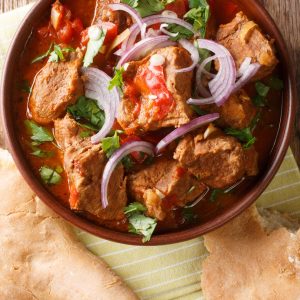
- Kharcho (Kharcho)
A thick, intensely flavored beef soup with walnuts, onions, sometimes tomatoes, and a generous amount of spice, including khmeli suneli (the Georgian spice blend). Harcho is deeply warming and more complex than any Western beef soup — the sour plum and walnut base give it a richness that’s uniquely Georgian.
💡 Local tip: Kharcho is best on a cold day in the mountains or after a long hike. It’s widely available in traditional restaurants across Georgia. Best eaten with Ghomi or Elarji (pain Georgian cornmeal porridge)
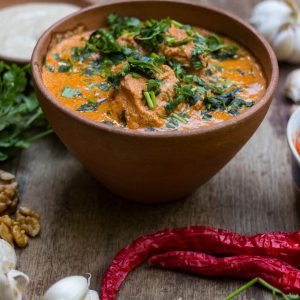
- Mtsvadi (Mtsvadi)
Georgian skewers (shashlik) – chunks of pork or beef cooked over an open grapevine fire. The grapevine wood gives the meat a distinctive smoky sweetness that sets Georgian mtsvadi apart from any other barbecue tradition. It’s eaten with raw onion, tkemali, and fresh bread.
💡 Local tip: Roadside Mtsvadi vendors appear across the countryside on weekends and holidays. The aroma is unmistakable – you’ll smell them from the car.
A vegetarian option can be made with mushrooms or other vegetables.
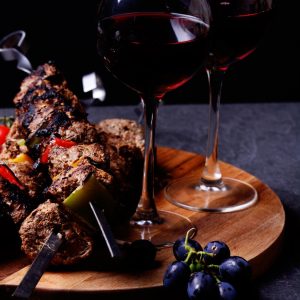
- Lobio in a clay pot (Lobio) – vegetarian
Slow-cooked kidney beans in a clay pot (ketsi), seasoned with coriander, fenugreek, garlic, and onion. Lobio is comfort food in its purest form – eaten at almost every Georgian table as a side dish or main. It comes mild or spiced, always deeply savory. The best eaten with fermented vegetables.
💡 Local tip: Lobio in a clay pot with Mchadi (cornbread) on the side is one of the most authentic budget meals you can eat in Georgia.
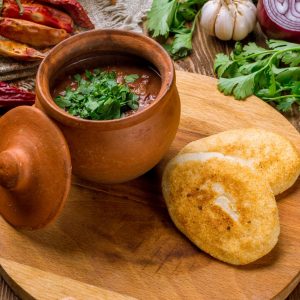
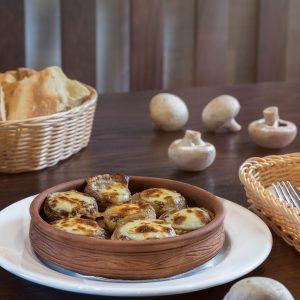
- Roasted mushroom in clay pan (Soko Ketsze) – vegetarian
Another vegetarian dish from Georgian cuisine is mushrooms in a clay pan (ketsi). This simple yet flavorful dish is prepared in traditional clay pans by placing mushroom heads upside down, covering them with cheese, and baking on high heat. Delicious flavors are created by combining mushroom juice and melted cheese.
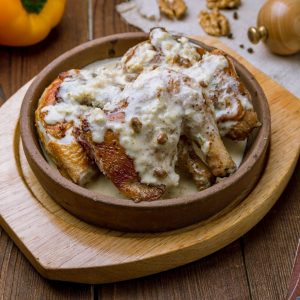
- Shkmeruli (Shkmeruli)
Shkmeruli is a popular chicken dish originating from the Racha region of Georgia. It is made with pan-roasted chicken served in a rich garlic sauce, traditionally presented in a clay dish
Walnut-Based Cold Dishes: Georgia’s Secret Ingredient
Walnuts are central to Georgian cooking in a way that has no real parallel in other cuisines. They appear in cold starters, stuffed vegetables, sauces, and sweets. If you enjoy walnuts, you will love Georgian food.
- Satsivi or Bazhe (satsivi or baje)
Poached chicken or turkey served cold in a thick walnut sauce spiced with garlic, onion, cloves, coriander, and fenugreek. The sauce is silky, complex, and faintly aromatic. Satsivi is a festive dish – traditionally made for New Year’s and major celebrations.
Bazhe is similar to Satsivi, but unlike Satsivi, its sauce is prepared without cooking. It is a walnut-based sauce made with Georgian spices and garlic. Perfect for roasted chicken or vegetables.
💡 Local tip: Satsivi is best eaten cold or at room temperature, not reheated. Many Tbilisi restaurants serve it year-round. It’s rich enough to be a full meal.
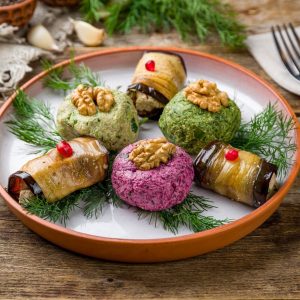
- Pkhali and Eggplant with walnut paste (Pkhali and Badrijani nigvzit) – vegetarian
A category of cold vegetable dishes rather than a single dish. Spinach, beet, green bean, or leek is finely minced, mixed with ground walnuts, garlic, onion, vinegar, and herbs, then shaped into small balls and garnished with a pomegranate seed. Pkhali platters are served as starters and are as beautiful to look at as they are to eat.
Eggplant is also commonly included in a Pkhali assortment but can be ordered separately too. Thin slices of fried aubergine are rolled around a filling of spiced walnut paste, garlic, and herbs, then typically garnished with pomegranate seeds and fresh coriander. Elegant, earthy, and completely addictive, it is one of the most popular dishes among first-time visitors to Georgia.
💡 Local tip: Order a mixed Pkhali platter (usually 3-4 types) as a starter. It’s vegetarian, nutritious, and a perfect introduction to Georgian flavors.
Badrijani nigvzit is almost always on the menu of any traditional Georgian restaurant. It’s vegetarian and makes an excellent starter with Mchadi (Georgian cornbread)
Georgian Soup
- Chikhirtma (Chikhirtma)
A light, sour chicken soup thickened with egg yolk and flour and sharpened with vinegar or lemon juice. Where Kharcho is heavy, Chikhirtma is delicate and restorative. It’s often recommended as a hangover cure in Georgia – a claim many travelers have tested and confirmed.
💡 Local tip: Chikhirtma is particularly associated with the morning after a Georgian feast (supra). Don’t be surprised to find it on breakfast menu.
Georgian Sweets & Drinks
- Churchkhela, Tklapi & Pelamushi (Tatara) (Churchkheta/Tklapi/Pelamushi)
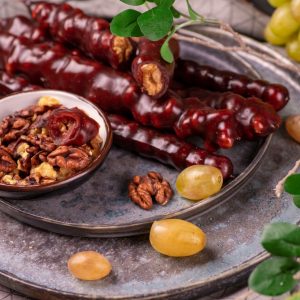
Often called the ‘Georgian Snickers’, churchkhela is a long string of walnuts or hazelnuts threaded on a thread and dipped repeatedly in thickened grape juice (Tatara) until it forms a chewy, sweet coating. It’s dried, kept for months, and eaten as a snack or dessert. The colors – dark purple or amber – come from different grape varieties.
💡 Local tip: You’ll see churchkhela hanging in bunches at every market and roadside stall across Georgia. Kakheti makes the best, as the region produces the grape juice used for the coating.
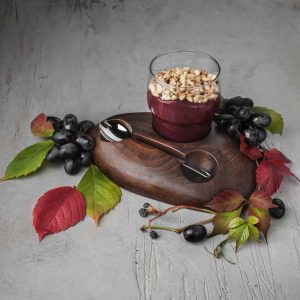
Tklapi is a dried fruit leather made from sour plum, cherry, or grape paste – tangy, chewy, and eaten as a snack. Pelamushi (Tatara) is a thick, wobbly grape pudding made from fresh grape juice and corn flour, often topped with walnuts. Both are uniquely Georgian and found almost nowhere else.
- Georgian Wine (Qvevri Wine) (Qvevris Ghvino)
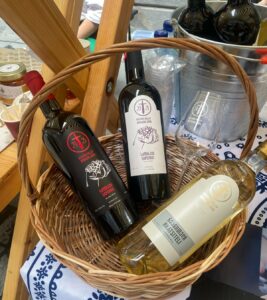
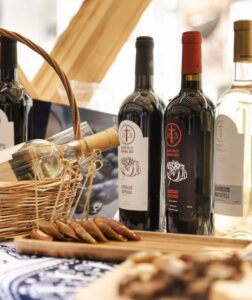
No food guide to Georgia is complete without wine – Georgia is the birthplace of wine, with 8,000 years of winemaking tradition. The most distinctive Georgian wine style is amber (or orange) wine: white grapes fermented with their skins in qvevri (clay vessels buried underground), producing a deep amber color, rich tannins, and complex dried-fruit and nutty flavors. It is nothing like any white wine you’ve tried.
💡 Local tip: Wine is food in Georgia. Kakheti is the main wine region. A self-drive wine route through the Alazani Valley is one of the best ways to experience it. Our car rental service makes exploring Kakheti easy.
The Georgian Supra with Tamada: More Than a Meal
To truly understand Georgian food, you need to experience a supra – a traditional Georgian feast. A supra is not just a meal; it is a ritual. The table is covered with cold dishes (pkhali, badrijani, lobio, salads), then hot dishes arrive one after another. Wine flows continuously. A tamada (toastmaster) usually a family member, leads the table offering toasts to life, family, guests, peace, and Georgia.
A Georgian family does not require a festive reason for a supra, and even one guest is more than enough to organize a multi-hour feast with plenty of wine and food. A full supra can last 4-6 hours. You will eat more than you thought possible. You will be offered more wine than you intend to drink. You will leave having made friends with everyone at the table. It is one of the great hospitality traditions in the world.
| 🍷 Georgian Wine Vocabulary
Qvevri – a clay vessel used for traditional winemaking, buried underground Rkatsiteli – the most widely grown white grape in Georgia Saperavi – the principal red grape; bold, dark, and tannic Amber/orange wine – white wine made with skin contact; Georgia’s signature style Chacha – Georgian pomace brandy (grappa equivalent); very strong Tamada – toastmaster at a Georgian feast |
Where to Try Georgian Food: A Short Guide
In Tbilisi
- Shavi Lomi – modern Georgian cuisine with seasonal ingredients
- Barbarestan – recipes from a 19th-century Georgian cookbook
- Cafe Littera – elegant Georgian cooking in a beautiful garden setting
- Any tone bakery in the Old Town – for fresh Shotis puri and Imeruli khachapuri
- Dezerter Bazaar – Tbilisi’s main food market; best place to buy local produce, spices, churchkhela, and Tklapi
- Pictograma or Zodiako – for delicious local Khinkali, Georgian dumplings.
- Bazari Orbelianze – a lively food market in the heart of Tbilisi, bringing together local flavors, modern food spots, and traditional Georgian specialties under one roof. Perfect for tasting a bit of everything in one place.
- Zeche – a stylish industrial-style food and social space, bringing together modern Georgian cuisine, creative concepts, cocktails, and a lively atmosphere under one roof. Great for dinner, drinks, and experiencing Tbilisi’s life, especially on Friday evenings.
In Kakheti
- Every Family guesthouse in Kakheti – home-cooked Georgian food and local wine
- Schuchmann Wines & Twins Wine House – winery restaurants serving regional dishes
In Svaneti
- Café Laila – one of the first cafes in Svaneti, offering Svanetian dishes in a cozy atmosphere.
- Old House Mestia serves delicious Georgian cuisine in the center of Mestia.
- Heshkili Huts – a local family business offering delicious local dishes and stunning views of the Svanetian mountains.
In Kutaisi
- Tomas’ wine cellar – a local winery hosted by Toma, a young winemaker dedicated to creating an unforgettable experience for every guest.
- Sisters Kutaisi (Debi) – a restaurant with beautiful design and local food with modern twists.
- Palaty Kutaisi is also a cozy café with an old-style interior and delicious Georgian food.
- Bikentia’s Kebabery – an old-but-gold local gem serving one thing exceptionally well: delicious Georgian kebab with tomato sauce and beer. Standing room only, with the nostalgic feel of the good old days.
Exploring by car makes reaching all these food regions easy. Explore our Georgia car rental options and create your own food road trip, or contact us to arrange a tailor-made tour designed just for you.
Frequently Asked Questions – Georgian Food
- Is Georgian food vegetarian-friendly?
More than you might expect. Pkhali, Badrijani nigvzit (eggplant with walnut paste), Lobio, Mchadi (Georgian cornbread), Ajapsandali (vegetable stew), and many other dishes are entirely plant-based. Georgia also has a strong Orthodox Christian tradition of fasting, which has produced an extensive repertoire of vegan dishes.
- Is Georgian food spicy?
Some dishes are spicy – Ostri, Megrelian dishes, and Adjika (red pepper paste) can have serious heat. But the majority of Georgian food is aromatic rather than hot, relying on walnut, herb, and spice combinations for flavor rather than chili heat.
- What is Khmeli suneli?
Khmeli suneli is Georgia’s essential spice blend – a mixture of dried fenugreek, coriander, marigold petals, dill, bay leaf, and other herbs. It’s used in many dishes and gives the Georgian cuisine much of its distinctive flavor. You can buy it at any market in Georgia
- Can I drink the tap water in Georgia?
Tap water in Tbilisi and major cities is clean and drinkable. In mountain villages you can drink fresh water from natural springs. In some rural areas, it’s worth asking locals or drinking bottled water. Georgia also has excellent natural mineral waters – Borjomi, from the spa town of the same name, is the most famous.
Plan Your Georgian Food Journey
Georgian cuisine rewards exploration. The best dishes in Kakheti are not the same as in Svaneti. A family guesthouse in the mountains will serve you food you won’t find in any Tbilisi restaurant. The most memorable meals are often the most unexpected ones – a roadside mtsvadi vendor, a glass of qvevri wine poured by a farmer, a plate of fresh Khinkali in a mountain village.
The best way to experience it all is to travel on your own schedule, stop where you want, and eat where locals eat.
→ Explore Georgia tours with Caucasus Trip
→ Rent a car and discover Georgia’s food regions at your own pace
→ Contact us for a tailor-made Georgia itinerary
About Caucasus Trip
Caucasus Trip is a family-run travel agency based in Tbilisi, Georgia, specializing in private tours, car rentals, and tailor-made experiences across Georgia, Armenia, and Azerbaijan.

Comment (0)