
The Ultimate Guide to UNESCO World Heritage Sites in the South Caucasus: Georgia, Azerbaijan & Armenia
South Caucasus tours are among the most rewarding adventures you can take in the world, and here’s why the region’s UNESCO-listed treasures should be at the top of every traveler’s bucket list.
Introduction: Why the South Caucasus Is One of the World’s Great Heritage Destinations
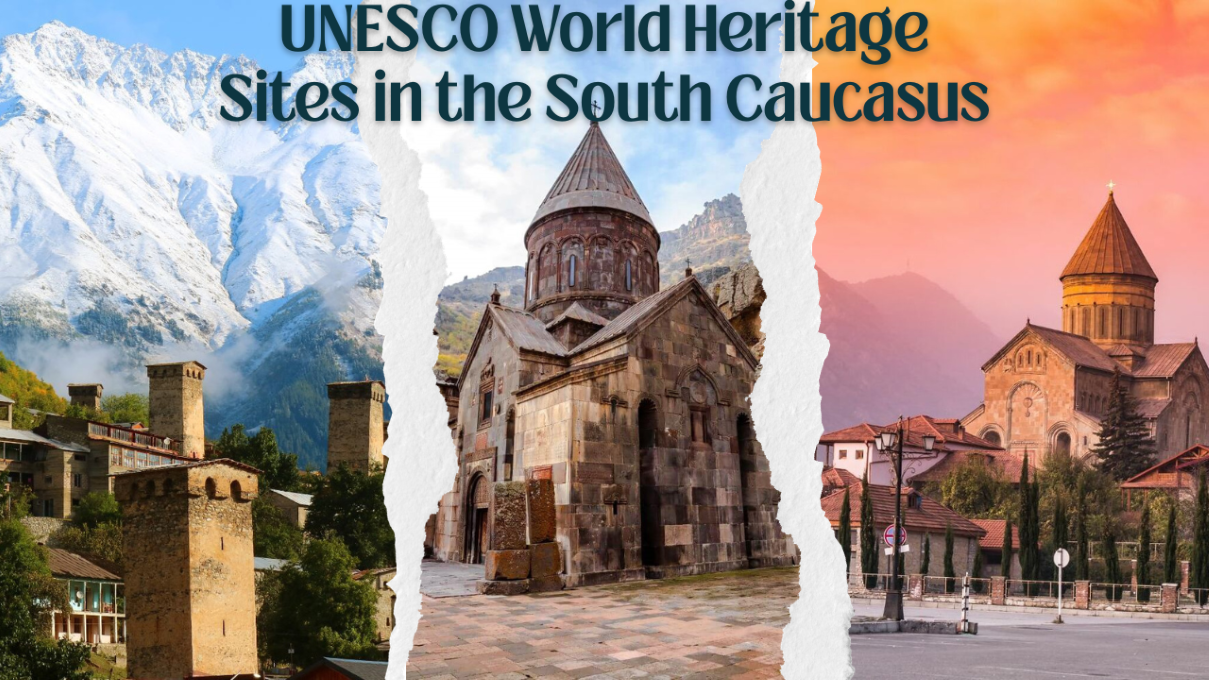
Nestled between Europe and Asia, the South Caucasus is one of the planet’s most culturally layered, historically profound, and scenically dramatic regions. The three countries that form it — Georgia, Azerbaijan, and Armenia — share millennia of connected history, yet each possesses a distinct identity that sets it apart. Together, they hold 12 UNESCO World Heritage Sites, ten cultural and two natural, ranging from ancient rock carvings and soaring medieval monasteries to primeval rainforests and nomadic cultural landscapes.
For travelers looking for South Caucasus tours that are out of the ordinary, these UNESCO-listed destinations provide something no mainstream tourist trail can match: the sensation of standing inside genuine history, where civilizations rose and fell, Christianity took root, Silk Road merchants traded spices for silk, and mountain communities have preserved their way of life for centuries without interruption.
This guide covers every UNESCO World Heritage Site in all three countries, including what makes each one unique, practical visit recommendations, and how to combine them for a smooth multi-country vacation.
UNESCO World Heritage Sites in Georgia: Where Ancient Kingdoms Left Their Mark
With four UNESCO-listed properties — three cultural and one natural — tours in Georgia provide an unparalleled sweep of human and ecological heritage. From the historic capital of Mtskheta to the distant tower villages of Svaneti, Georgia rewards any traveler who ventures beyond Tbilisi.
1. Historical Monuments of Mtskheta (Inscribed 1994)
Location: Mtskheta, 20 km northwest of Tbilisi
The historic churches of Mtskheta, the former capital of Georgia, are outstanding examples of medieval religious architecture in the Caucasus, reflecting the high artistic and cultural level of this ancient kingdom. Mtskheta served as the ancient capital of Kartli, the East Georgian Kingdom, from the 3rd century BC to the 5th century AD, and was the location where Christianity was proclaimed as the official religion of Georgia in 337 AD.
The UNESCO listing encompasses three key monuments: Jvari Monastery, Svetitskhoveli Cathedral, and Samtavro Convent, all located in the ancient capital of Mtskheta, just 20 km north of Tbilisi.
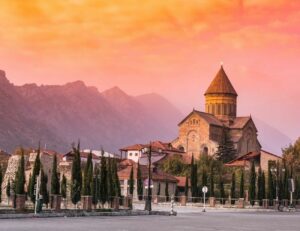
Svetitskhoveli Cathedral, built between 1010 and 1029, is considered one of the holiest places in the Georgian Orthodox world. It houses the robe of Christ — one of the most sacred relics in Christianity — and served for centuries as the burial site of Georgian kings. Jvari Monastery, perched dramatically on a hilltop at the confluence of the Aragvi and Mtkvari rivers, is widely regarded as a masterpiece of Early Christian architecture. The views from its walls are among the most iconic in the entire country.
Why it matters for South Caucasus tours: Mtskheta is the spiritual heart of Georgia, and no tour of the country is complete without it. Its proximity to Tbilisi makes it an easy and deeply enriching day trip.
Practical tip: Hire a local guide — the monastery interiors are rich with symbolism and history that only become truly meaningful with expert context.
2. Gelati Monastery (Inscribed 1994)
Location: Near Kutaisi, western Georgia
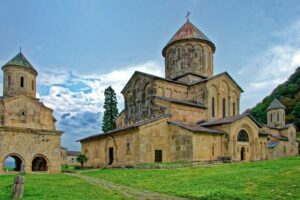
The Gelati Monastery represents medieval Georgia’s prosperous period known as the ‘golden age,’ which flourished during the reigns of King David IV ‘the Builder’ (1089–1125) and Queen Tamar (1184–1213). King David initiated the monastery’s construction in 1106 near his capital of Kutaisi, on a wooded hill by the river Tskaltsitela. Intricate mural paintings dating from the 12th to 17th centuries adorn the monastery, alongside a 12th-century mosaic in the main church’s apse, portraying the Virgin with Child surrounded by archangels.
From 1130 AD onwards, scholars and intellectuals from across Europe visited Gelati. This is where Plato’s works were first translated into Georgian, and where many of the country’s most precious religious texts and manuscripts were stored in a special scriptorium.
Gelati was not merely a monastery — it was Georgia’s greatest medieval university, a place where philosophy, theology, and science were taught and practiced at the highest levels of the age. King David the Builder himself is buried at its entrance gate, and the monastery contains the largest collection of Byzantine and post-Byzantine paintings in all of Georgia.
Why it matters for South Caucasus tours: Gelati is the cultural crown of western Georgia. Combined with nearby Kutaisi — itself a candidate for UNESCO inscription — it offers a profound immersion into the Georgian Golden Age.
3. Upper Svaneti (Inscribed 1996)
Location: Mestia and Ushguli, Greater Caucasus Mountains, northwestern Georgia
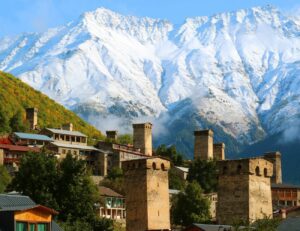
Upper Svaneti is probably Georgia’s most iconic UNESCO site. Recognized for its stone tower houses that stand tall and proud in verdant valleys against the backdrop of the Greater Caucasus mountains, there are more than 200 of these towers in the village of Chazhashi alone. Built by the Svans — the ethnic group that has traditionally inhabited this part of Georgia — the structures have up to five floors and were once used as fortified family dwellings.
The Upper Svaneti region, in addition to its cultural significance, is celebrated for its alpine meadows, forests, and glaciers that support a variety of wildlife, including several species of birds and mammals endemic to the Caucasus region. The natural beauty and ecological importance of the region have been recognized by UNESCO since 1996.
The village of Ushguli, at approximately 2,200 meters above sea level, is one of the highest permanently inhabited communities in Europe. Arriving here — whether by 4×4 in summer or on foot — feels like stepping back eight centuries. The medieval towers rise against the white teeth of Mt. Shkhara (5,193 m), Georgia’s highest peak, creating a panorama that has no equal.
Why it matters for South Caucasus tours: Svaneti is the definitive adventure heritage destination of Georgia. It draws hikers, cultural travelers, and photographers alike. The combination of spectacular mountain scenery and living medieval culture is utterly unique.
Practical tip: Base yourself in Mestia and explore the countryside by hiking or scenic 4×4 driving. Check our Svaneti hiking guide for more information.
4. NATURAL: Colchic Rainforests and Wetlands (Inscribed 2021)
Location: Western Georgia, along the Black Sea coast
The Colchic Rainforests and Wetlands, listed in 2021, represent the only natural UNESCO site in Georgia. Located along Georgia’s western Black Sea coast, the forests are a unique biodiversity hotspot home to several endemic and endangered species, recognized for their importance in maintaining global ecological balance.
These ancient forests — a relic of forests that survived the Ice Age — contain endemic species of rhododendron, laurel, and cherry-laurel found nowhere else on earth. They represent a living connection to the flora of the Tertiary period, millions of years before human civilization emerged.
Why it matters for South Caucasus tours: The Colchic forests offer a completely different dimension to Georgia tours — a pristine natural heritage that complements the country’s extraordinary cultural sites.
UNESCO World Heritage Sites in Azerbaijan: Where East Meets West
With five UNESCO World Heritage Sites, Azerbaijan tours take travelers on a journey through millennia of human history — from the world’s oldest rock art to a Silk Road city of legendary craftsmanship. Azerbaijan sits at the crossroads of civilizations, and its UNESCO sites tell that story with stunning clarity.
5. Walled City of Baku with Shirvanshah’s Palace and Maiden Tower (Inscribed 2000)
Location: Baku Old City (Icherisheher), Azerbaijan’s capital
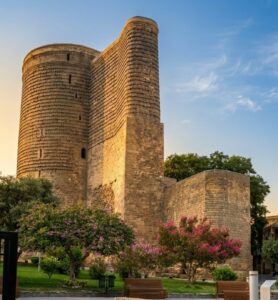
Located in the heart of Azerbaijan’s capital, the Walled City of Baku showcases a rich tapestry of architectural styles and cultural influences, including Zoroastrian, Sassanid, Arabic, Persian, Shirvan, Ottoman, and Russian. The city’s defensive walls and the iconic Maiden Tower, built in the 12th century, stand atop remnants of structures dating back to the 7th and 6th centuries BC.
Inside the Walled City of Baku are several important ruins and monuments, with two singled out for inclusion on the UNESCO World Heritage List. The iconic Maiden Tower’s exact history remains unknown, with theories ranging from a Zoroastrian fire temple to a defensive fortress. Visitors can climb to the top for panoramic views of the city and the Caspian Sea.
The 15th-century Shirvanshah Palace complex — the royal residence of one of Azerbaijan’s most powerful dynasties — is a masterpiece of Azerbaijani medieval architecture. The Old City itself remains a living, breathing neighborhood where locals still reside among structures that have stood for a thousand years, giving it an authenticity that is increasingly rare among heritage sites worldwide.
Why it matters for South Caucasus tours: Baku’s Old City is the most accessible UNESCO site in the region, easily explored on foot from any hotel in the capital. It is the ideal starting point for any Azerbaijan tour.
6. Gobustan Rock Art Cultural Landscape (Inscribed 2007)
Location: Gobustan, 64 km southwest of Baku
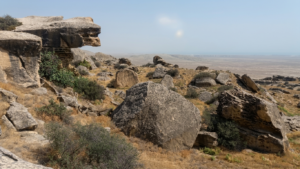
The Gobustan Rock Art Cultural Landscape features over 6,000 petroglyphs in the semi-desert region of the Gobustan reserve, with the oldest dating back 40,000 years. These rock drawings depict men, women, the sun, totems, hunting, fishing, and much more. Also found are fragments of inhabited caves, settlements, and burials, indicating habitation since the late Paleolithic era.
Some petroglyphs featuring ships reflect a connection with the Mediterranean, while others feature images of humans and animals, particularly in hunting scenes. The Gobustan Rock Art Cultural Landscape was first awarded UNESCO World Heritage List status in 2007.
Gobustan is among the world’s most significant sites of prehistoric art. Standing before these ancient engravings — carved by human hands tens of thousands of years before the pyramids were built — is a profoundly humbling experience. The site also includes mud volcanoes nearby, which add a surreal geological spectacle to the visit.
Why it matters for South Caucasus tours: Gobustan is typically combined with a Baku day trip and can be paired with the nearby mud volcanoes and the ancient Zoroastrian fire temple of Ateshgah for a remarkable full-day excursion into Azerbaijan’s prehistoric and ancient past.
7. Historic Centre of Sheki with the Khan’s Palace (Inscribed 2019)
Location: Sheki, northwestern Azerbaijan
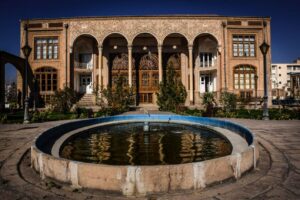
Nestled in the foothills of the Greater Caucasus Mountains, Sheki was a significant stop on the ancient Silk Road, flourishing as a center for sericulture and trade. The crown jewel of Sheki is the Palace of Shaki Khans, a stunning 18th-century summer residence built without a single nail. Its most striking feature is the exquisite “shebeke” — intricate stained-glass windows crafted from thousands of small pieces of colored glass set into a wooden lattice.
The palace features two mirrored balconies and six uniquely decorated rooms, each boasting intricate designs in striking colors. The walls and ceilings are adorned with detailed artwork, and the stained-glass windows consist of 5,000 individual fragments per square meter.
Beyond the palace, the old town of Sheki enchants visitors with its cobblestone streets, traditional caravanserais (Silk Road inns), and the warm hospitality of its people. The city’s culinary traditions — most notably piti, a slow-cooked lamb and chickpea stew served in individual clay pots — are among the most celebrated in Azerbaijan.
Why it matters for South Caucasus tours: Sheki is the hidden gem of Azerbaijan. Its combination of Silk Road atmosphere, remarkable palace architecture, and natural mountain beauty makes it an essential stop on any extended tour.
8. Cultural Landscape of Khinalig People and “Köç Yolu” Transhumance Route (Inscribed 2023)
Location: Greater Caucasus Mountains, northern Azerbaijan
Situated about 2,300 metres above sea level in the Greater Caucasus Mountains, Khinalig is a small village dating back to the Bronze Age. The people living in this isolated region speak their own language and have unique customs. UNESCO has recognized the region’s culture and specifically the landscape of the 200-kilometre Köç Yolu Transhumance Route, along which nomadic inhabitants migrate between seasons, adapting to the agricultural conditions.
Khinalig is one of the most isolated and oldest continuously inhabited villages in the world. Its inhabitants speak a language — Khinalig — that belongs to no other language family on earth, a linguistic island that has survived for millennia in the folds of the Caucasus Mountains. Visiting here is a journey to the very edge of the known world.
Practical tip: Khinalig requires a 4×4 vehicle due to challenging mountain roads. Best visited in summer or early autumn.
9. NATURAL: Hyrcanian Forests (Inscribed 2019, Extended 2023)
Location: Southern Azerbaijan, along the Caspian Sea coast (shared with Iran)
The Hyrcanian Forests are mixed broadleaf forests, with the first trees appearing 25–50 million years ago. These forests once covered vast territories, and today provide habitat for 58 species of animals and 180 species of birds. The oldest trees still standing today are 500 years old.
These ancient forests, which survived glacial periods that wiped out similar ecosystems across the Northern Hemisphere, are a living relic of a world that existed long before humans walked the earth. The endangered Persian Leopard still roams these forests today.
UNESCO World Heritage Sites in Armenia: The Cradle of Christianity
Armenia holds three UNESCO World Heritage Sites, all of them sacred monuments that carry the weight of nearly two thousand years of Christian faith and Armenian culture. Armenia tours centered on these sites are pilgrimages as much as they are travel experiences — journeys into the soul of one of the world’s oldest civilizations.
10. Monasteries of Haghpat and Sanahin (Inscribed 1996, Extended 2000)
Location: Lori Region, northern Armenia (near Alaverdi)
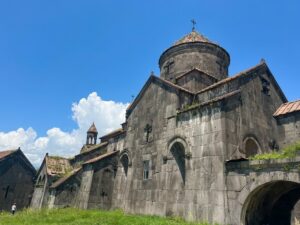
These two Byzantine monasteries in the Tumanian region date from the period of prosperity during the Kiurikian dynasty (10th to 13th centuries) and were important centers of learning. Sanahin was renowned for its school of illuminators and calligraphers. The two monastic complexes represent the highest flowering of Armenian religious architecture, whose unique style developed from a blending of elements of Byzantine ecclesiastical architecture and the traditional vernacular architecture of the Caucasian region.
These complexes acted as spiritual, cultural, and educational centers, focused on philosophy, medicine, rhetoric, and music.
Set dramatically above the deep Debet River gorge, Haghpat and Sanahin are among the most beautifully situated monuments in the entire South Caucasus. The two monasteries sit within walking distance of each other, surrounded by lush forests, and together they tell the story of Armenian intellectual life at its medieval zenith. The intricately carved khachkars (cross-stones) found throughout the complexes are masterpieces of Armenian stone sculpture.
Why it matters for South Caucasus tours: These monasteries are typically visited on a day trip from Yerevan or Dilijan and are frequently included in multi-country Caucasus itineraries. The combination of natural beauty and historical depth is extraordinary.
11. Cathedral and Churches of Echmiatsin and the Archaeological Site of Zvartnots (Inscribed 2000)
Location: Vagharshapat (Echmiadzin), near Yerevan
Etchmiadzin Cathedral is the mother church of the Armenian Apostolic Church and one of the finest examples of Christian era architectural monuments. It was built in the early 4th century, right after Christianity was spread by Gregory the Illuminator and acknowledged as the state religion of Armenia.
Also in Echmiadzin are the Church of St. Gayane and the Temple of St. Ripsime, built no later than the 7th century, and the Shoghakat Temple, built at the end of the 17th century. Nearby lies the archaeological site of Zvartnots, containing the remnants of a 7th-century medieval temple and its surroundings. Built in the 7th century, the church was not fully preserved due to a significant earthquake during the Middle Ages, and only exquisite architectural elements remain, discovered by archaeologists in the 20th century.
Echmiadzin is, in effect, the Vatican of the Armenian world. Armenia was the first nation to adopt Christianity as its state religion in 301 AD, and Echmiadzin has been the spiritual center of the Armenian Apostolic Church since that moment. Attending a service here is one of the most moving cultural experiences available to any traveler in the South Caucasus.
Why it matters for South Caucasus tours: Echmiadzin is just 20 km from Yerevan, making it an essential half-day excursion. For travelers on Armenia tours, it is the single most important site in the country.
12. Monastery of Geghard and the Upper Azat Valley (Inscribed 2000)
Location: Kotayk Province, 35 km southeast of Yerevan
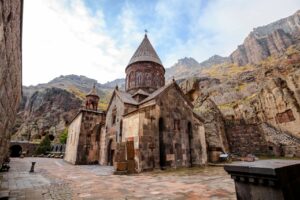
The monastery of Geghard contains a number of churches and tombs, most of them cut into the rock, which illustrate the very peak of Armenian medieval architecture. The complex of medieval buildings is set into a landscape of great natural beauty, surrounded by towering cliffs at the entrance to the Azat Valley.
It was renamed Geghard in the 14th century because the monastery was used to keep the Spear of Destiny — also known as the Holy Lance — that pierced the ribs of Christ, under its roof for over 500 years.
Part carved into the living rock and part built against sheer cliff faces, Geghard is an architectural feat that seems impossible until you stand before it. The acoustics inside the rock-hewn chambers are extraordinary — if you are lucky enough to encounter Georgian or Armenian sacred choral singing inside its walls, it is an experience that stays with you for life.
Why it matters for South Caucasus tours: Geghard is almost always combined with the nearby Garni Temple (a beautifully preserved 1st-century Hellenistic temple, the only surviving pagan structure in Armenia) on a single day trip from Yerevan. Together, they form one of the most unforgettable day excursions in the entire Caucasus region.
Planning Your South Caucasus UNESCO Tour: Practical Travel Tips
Best Time to Visit
Spring (April–May) and autumn (September–October) offer the ideal combination of pleasant temperatures, clear skies, and lush landscapes across all three countries. Summer can be hot in Baku and Yerevan, while the mountain sites of Svaneti and Khinalig are best accessed from June to October when roads are clear.
Getting Between the Countries
- Georgia and Armenia: Direct bus and minibus services connect Tbilisi to Yerevan (approximately 5–6 hours). Many organized South Caucasus tours cover all three countries in a single multi-week itinerary. Direct flights from Tbilisi to Yerevan are also available.
- Azerbaijan to Georgia: Travel between Georgia and Azerbaijan is a bit unusual right now as Azerbaijan’s land borders are still restricted for normal tourist entry. Land border from Georgia to Azerbaijan is still not open for ordinary tourists. Tourists are able to exit Azerbaijan into Georgia by crossing the Red Bridge or the Lagodekhi border. Two way flights from Tbilisi to Baku are still available.
- Armenia to Azerbaijan: There are no direct land or air connections between the two countries due to political tensions. Travelers visiting both must transit through Georgia.
Combining All Three Countries
A 14–17 day itinerary comfortably covers the major UNESCO sites across all three countries:
- Days 1–4: Baku, Gobustan, and surroundings (Azerbaijan tours)
- Days 5–7: Sheki and northern Azerbaijan
- Days 8–10: Tbilisi, Mtskheta, Gelati, and Kutaisi (tours in Georgia)
- Days 11–12: Svaneti (optional extension)
- Days 13–15: Yerevan, Echmiadzin, Geghard, and Garni (Armenia tours)
- Days 16–17: Haghpat and Sanahin
Guided vs. Independent Travel
While independent travel is entirely possible in all three countries, joining a professionally guided South Caucasus tour adds enormous value when visiting UNESCO sites. Local guides bring the history alive, navigate logistical challenges, and provide access to cultural experiences that independent travelers often miss — from joining a Georgian feast (supra) in Svaneti to attending Sunday Mass at Echmiadzin.
Why South Caucasus Tours Belong on Every Serious Traveler’s List
The South Caucasus is not a region that shouts for your attention. It doesn’t have the global marketing budgets of Western Europe or Southeast Asia. What it has instead is something far rarer: authenticity. The kind that comes from civilizations that are still very much alive, still speaking their ancient languages, still singing their polyphonic songs, still pouring their natural wine from clay vessels buried in the earth.
The South Caucasus countries of Georgia, Armenia, and Azerbaijan are home to dozens of languages, religions, landscapes, and musical styles, with UNESCO World Heritage Sites ranging from Geghard Monastery to Svaneti’s ancient watchtowers, along with numerous UNESCO-recognized intangible cultural treasures — from carpet weaving to spine-tingling polyphonic singing.
Whether you are a history enthusiast tracing the footsteps of ancient kingdoms, a nature lover drawn to primeval forests and mountain landscapes, or a cultural traveler seeking the kind of genuine hospitality that has all but disappeared from well-trodden paths, South Caucasus tours deliver an experience that is, quite simply, unlike anything else on earth.
The 12 UNESCO World Heritage Sites of Georgia, Azerbaijan, and Armenia are not merely monuments to the past. They are living proof that some places in this world have managed to hold onto something precious — and that those of us fortunate enough to visit carry a responsibility to help protect them for the generations that will follow.

Comment (0)