

10 Days in Georgia is the perfect amount of time to experience the country properly. Long enough to feel the rhythm of the country, short enough to keep every day exciting. In 10 days, you can explore the winding streets of Tbilisi, taste wine from clay vessels buried underground in Kakheti, stand at the foot of the Caucasus Mountains, marvel at ancient cave cities, walk through Europe’s highest inhabited village in Svaneti, and finish with your feet near the Black Sea in Batumi.
This itinerary is designed for first-time visitors who want to see the highlights without rushing. Every destination is connected by road, and the route flows logically — you’re never backtracking unnecessarily.
Before You Go: Essential Georgia Travel Tips
Visa: Georgia offers visa-free entry to citizens of most countries, including the US, EU, UK, and Australia, for stays up to 365 days. Check the Georgian e-Visa portal for your specific nationality.
Currency: Georgian Lari (GEL). ATMs are widely available in cities; carry cash for rural areas and smaller guesthouses.
Language: Georgian is the official language, but English is widely spoken in tourist areas. Russian is understood by older generations.
Getting around: For this itinerary, the best option is a private driver or car rental (both bookable through Caucasus Trip). Marshrutkas (public shared transport) connect major destinations, but add time and logistical complexity. Additionally, most of the drivers can’t speak English. A private transfer lets you stop for photos, change plans, and arrive relaxed.
Best time to go: May–June and September–October for mild weather and fewer crowds. July–August is peak season — hot in the lowlands, perfect in the mountains.
Day 1: Arrive in Tbilisi
Stay: Tbilisi (Old and New Town)
Arrive in Tbilisi and give yourself the evening to settle in. Walk the cobblestone streets of the Old Town, cross the Bridge of Peace over the Mtkvari River, and find a table at a traditional Georgian restaurant for your first supra — the legendary Georgian feast.
Must try tonight:
- Khinkali (Georgian soup dumplings) — the correct way to eat them is with your hands
- Mtsvadi (Georgian skewers) with tkemali plum sauce
- Khachapuri (Georgian cheese bread) – filled with melted local cheese
- Georgian famous salad – with delicious local herbs and walnut paste
- A glass of amber Rkatsiteli wine
Where to walk: Shardeni Street, Abanotubani (sulfur bath district), Narikala Fortress lit up at night, Leghvtakhevy Canyon to see the hidden waterfall
Day 2: Tbilisi – Qvevri Workshop – Alaverdi Monastery – Tsinandali – Telavi
Stay: Telavi, Kakheti
Today you leave Tbilisi and head northeast into Kakheti — Georgia’s legendary wine region — with two extraordinary stops along the way.
Morning: Begin with a hands-on Qvevri workshop, where you’ll learn about Georgia’s 8,000-year-old winemaking tradition directly from a local craftsman. Qvevri are large clay vessels buried underground for fermenting and aging wine — a UNESCO-recognized tradition unlike anything else in the world. This is not a museum exhibit; it’s a working craft passed from generation to generation.
Late morning: Visit Alaverdi Monastery — one of the tallest and most awe-inspiring medieval cathedrals in Georgia, rising dramatically from the flat Alazani Valley floor. The monastery has been producing wine in its cellars since the 11th century, and monks still tend the vineyards today. The combination of spiritual grandeur and living winemaking tradition makes Alaverdi unlike any other stop on this journey.
Afternoon: Continue to Tsinandali Estate — the 19th-century wine estate of celebrated Georgian poet Alexander Chavchavadze. The beautifully restored manor house sits within an English landscape garden and houses a wine museum tracing Kakheti’s winemaking history. Enjoy a complimentary glass of wine in the cellar before continuing to Telavi.
Evening: Arrive in Telavi, the regional capital of Kakheti.
Day 3: Telavi – Gremi – Khareba Winery – Sighnaghi – Bodbe – Tbilisi
Stay: Tbilisi
A full final day in Kakheti before returning to Tbilisi in the evening, covering the region’s most iconic stops.
Morning: Drive north from Telavi to Gremi — a 16th-century royal citadel and the former capital of the Kakheti Kingdom. The fortress tower and Church of the Archangels stand remarkably intact, with sweeping views over the Alazani Valley and the Caucasus Mountains beyond. One of the most underrated historical sites in Georgia.
Mid-morning: Head to Khareba Winery — Georgia’s most dramatic wine estate, with 7.7km of tunnels carved directly into the Caucasus Mountains for wine aging and storage. Tour the underground cellars at a constant natural temperature and taste wines poured directly from Qvevri. The scale and atmosphere here are extraordinary.
Afternoon: Drive south to Sighnaghi — Georgia’s most romantic hilltop town, surrounded by 18th-century fortress walls with 23 towers. The cobblestone streets, colourful balconied houses, and panoramic views over the Alazani Valley make it one of the most photogenic places in the country. Browse the artisan shops and stop for lunch here.
Just below Sighnaghi, visit Bodbe Monastery — a serene working nunnery and the burial place of St. Nino, who brought Christianity to Georgia in the 4th century. The monastery gardens are exceptionally peaceful, with long views over the valley.
Evening: Drive back to Tbilisi (approximately 2 hours) and check in for the night.
Day 4: Tbilisi – Jvari Monastery – Ananuri – Kazbegi – Gudauri
Stay: Gudauri or Kazbegi (Stepantsminda)
Today you drive north on the legendary Georgian Military Highway — one of the great scenic drives of the Caucasus, climbing from Georgia’s ancient heartland through dramatic mountain gorges all the way to the peaks of the Greater Caucasus.
First stop: Jvari Monastery — perched on a cliff above the confluence of the Aragvi and Mtkvari rivers, this 6th-century monastery is a UNESCO World Heritage Site and one of the defining images of Georgia. The view from the monastery over ancient Mtskheta and the two rivers meeting below is magnificent. Below, explore Svetitskhoveli Cathedral in Mtskheta — the most sacred cathedral in Georgia, built on the site where Christ’s robe is said to be buried.
Mid-morning: Continue north along the Military Highway to Ananuri Fortress — a beautifully preserved 17th-century castle complex dramatically positioned on the shores of the Zhinvali Reservoir. Walk the ramparts, explore the twin churches inside the walls, and take in the turquoise-blue water of the reservoir.
Afternoon: Continue climbing into the mountains. The road passes through Gudauri ski resort and over the Jvari Pass at 2,395m, where the famous Soviet-era Friendship Monument marks the highest point of the highway. Stop for photos — on clear days the views stretch deep into the Caucasus in both directions.
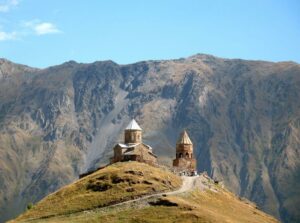
Arriving in Kazbegi (Stepantsminda): The town sits at 1,740m at the foot of Mount Kazbek (5,033m), with Gergeti Trinity Church visible on its promontory above. One of the great arrival moments in Georgian travel.
Evening: Overnight in Gudauri or Kazbegi. Dinner with mountain views as the sun sets behind the peaks.
Day 5: Gudauri – Gori – Uplistsikhe – Kutaisi
Stay: Kutaisi
Today you descend from the mountains and head west through the heartland of historic Georgia, combining two very different but equally fascinating stops before reaching Kutaisi.
Morning: Gori — the birthplace of Joseph Stalin. Whether or not you’re interested in Soviet history, the Stalin Museum is a genuinely fascinating and thought-provoking experience — covering the man who shaped the 20th century from his childhood in this small Georgian town to the height of Soviet power. The museum itself is an extraordinary Soviet-era time capsule.
Late morning: Uplistsikhe — just 10km east of Gori, this extraordinary rock-hewn cave city dates back to the early Iron Age (around 1000 BC) and was once one of the most important urban centers in the entire Caucasus. Over 700 cave rooms, temples, halls, and a 9th-century Christian basilica are carved directly into the volcanic rock above the Mtkvari River. The scale and age of this place are genuinely humbling.
Afternoon: Drive west to Kutaisi — Georgia’s second city and ancient capital of the Colchis kingdom (yes, the same kingdom from the Greek myth of Jason and the Golden Fleece). Arrive in the afternoon and take an evening stroll along the Rioni River.
Evening: Kutaisi has a relaxed, authentic atmosphere with few tourists and excellent local restaurants. Try Kharcho, Pkhali and Georgian corn bread with Imeretian cheese
Day 6: Kutaisi – Gelati Monastery – Prometheus Cave – Mestia
Stay: Mestia, Svaneti
A packed morning in Kutaisi before the long but spectacular drive north into the mountains of Svaneti.
Morning: Gelati Monastery — commissioned in 1106 by King David the Builder, one of the greatest rulers in Georgian history, Gelati is considered the pinnacle of the Georgian Golden Age. The main cathedral contains some of the finest medieval mosaics in the entire Caucasus. King David himself is buried here, beneath the gate arch — legend says he requested this so all who entered would walk over his grave. A UNESCO World Heritage Site and deeply moving place.
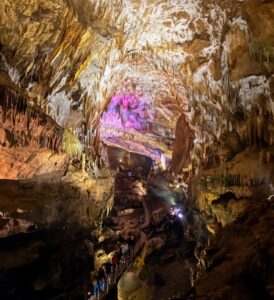
Mid-morning: Prometheus Cave — Georgia’s most spectacular limestone cave system, just outside Kutaisi. The 1,400-metre underground route passes through chambers of extraordinary stalactites, stalagmites, underground waterfalls, and illuminated mineral formations. An optional boat ride along the underground river is the perfect ending to the cave tour.
Afternoon: Begin the drive north to Mestia — the gateway to Svaneti. The route climbs through increasingly dramatic mountain scenery as you enter the Enguri River gorge and ascend into the Greater Caucasus. The final section of road into Mestia is one of the most scenic mountain drives in Georgia.
Evening: Arrive in Mestia and check into your guesthouse. The iconic Svan watchtowers rise from the rooftops around you — welcome to one of the most extraordinary corners of Europe.
Day 7: Mestia – Ushguli – Mestia
Stay: Mestia
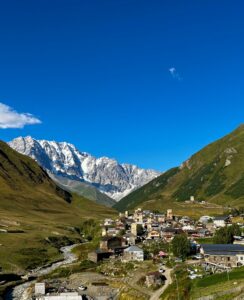
Today is one of the most memorable days of the entire trip — a full-day excursion to Ushguli, the highest permanently inhabited village in Europe and a UNESCO World Heritage Site.
The drive from Mestia to Ushguli (approximately 45km each way) follows a mountain road through the Enguri River gorge past medieval Svan tower villages, alpine meadows, and glacier views. The road itself is an adventure — expect stunning scenery at every turn.
Ushguli sits at 2,100 metres beneath the towering face of Mount Shkhara (5,193m — Georgia’s highest peak), with over 200 ancient stone watchtowers rising from the cluster of four villages that make up the settlement. People have lived here continuously for over a thousand years, maintaining traditions largely unchanged by the outside world.
Spend 2–3 hours exploring the villages on foot: visit the Lamaria Church, walk through the lanes between the watchtowers, and look out across the glacier valley toward Shkhara. The sense of remoteness and timelessness here is unlike anywhere else in Georgia.
Return to Mestia in the afternoon. The evening is yours to explore the town — visit the local market, try Svan salt (a unique spice blend unique to this region), and enjoy a home-cooked dinner with your guesthouse family.
Day 8: Mestia – Batumi
Stay: Batumi
After breakfast, visit the Svaneti History and Ethnography Museum in Mestia — a remarkable collection of historical artefacts from the Svaneti region, including unique icons and engravings, a rich collection of manuscripts, medieval weaponry, and iron, silver, and copper ornaments, as well as jewellery, pottery, textiles, and other items depicting the ancient culture of the Svan people. For a region so remote, the sophistication and artistry of these objects is astonishing.
Optional alternative: Instead of the museum, if the weather permits, replace this morning with a 4×4 trip to Koruldi Lakes — glacial lakes set at around 2,700 metres above Mestia with panoramic views of the majestic Tetnuldi Mountains reflected in the water. The lakes themselves are not particularly large, but the vistas are exceptional. Note: an additional fee applies for this excursion.
Afternoon: Drive south from Mestia to Batumi — Georgia’s vibrant Black Sea city in the Adjara region. The road descends from the high Caucasus through the lush, subtropical Adjara lowlands, and the contrast with the mountain world you’ve just left is dramatic. The air becomes warmer, the vegetation greener, and the Black Sea opens up ahead.
Arriving in Batumi: Check into your hotel and take an evening walk along the famous Batumi Boulevard — a palm-lined promenade stretching along the Black Sea shore. After the mountain days, the sea air, the city lights, and the sound of waves feel like a completely different country.
Day 9: Batumi – Tbilisi
Stay: Tbilisi
Your final full day begins with a morning to enjoy Batumi before the drive back to Tbilisi.
Morning in Batumi: Explore the Old Town — a charming historic quarter of Ottoman-era architecture, ornate balconies, and colourful facades very different in character from Tbilisi. Browse the covered market for Georgian spices, churchkhela (walnut-filled grape candy), adjika (spicy Georgian condiment), and local Adjaran honey to take home.
Don’t miss the Batumi Botanical Garden on the cliff above the city — one of the most biodiverse botanical collections in Europe, with extraordinary views over the Black Sea from the upper terraces.
Afternoon: Drive back to Tbilisi (approximately 5–6 hours along the main highway through western Georgia). Your driver will find the best spots to stop for photos and refreshments along the way.
Evening: Arrive back in Tbilisi for your last night in Georgia. Return to a favourite restaurant from Day 1, or explore a neighbourhood you didn’t have time for earlier. The city will feel different now — seen through the lens of everything you’ve experienced over the past 9 days.
Day 10: Departure from Tbilisi
Your Georgian adventure comes to an end today. Depending on your flight time, you may have a final morning to revisit the Old Town, pick up last-minute gifts from the Dry Bridge market, or simply sit with a coffee and watch Tbilisi wake up one last time.
Last-minute shopping: Tbilisi’s covered Deserter’s Market is the best place for Georgian wine to take home, local churchkhela, dried herbs, and spices. The craft shops along Shardeni Street are good for jewellery, ceramics, and traditional Georgian artwork.
Transfer to Tbilisi International Airport for your departure. Georgia has a way of staying with you long after you leave — in the taste of the wine, the memory of the mountains, and the warmth of the people you met along the way.
Until next time!
10 Days in Georgia Itinerary: Summary
| Day | Route | Highlights |
| 1 | Tbilisi | Arrive, Old Town, Narikala, first supra |
| 2 | Tbilisi → Telavi | Qvevri workshop, Alaverdi Monastery, Tsinandali Estate |
| 3 | Telavi → Tbilisi | Gremi, Khareba Winery, Sighnaghi, Bodbe Monastery |
| 4 | Tbilisi → Kazbegi | Jvari Monastery, Mtskheta, Ananuri, Kazbegi, Jvari Pass |
| 5 | Kazbegi → Kutaisi | Gori & Stalin Museum, Uplistsikhe cave city |
| 6 | Kutaisi → Mestia | Gelati Monastery, Prometheus Cave, drive to Svaneti |
| 7 | Mestia → Ushguli → Mestia | Ushguli (the highest village in Europe), Svan towers, Mount Shkhara |
| 8 | Mestia → Batumi | Svaneti Museum (or Koruldi Lakes), drive to Black Sea |
| 9 | Batumi → Tbilisi | Batumi Old Town, Botanical Garden, return to Tbilisi |
| 10 | Tbilisi | Departure |
Want This Trip Handled for You?
Planning transport, accommodation, and guides across 10 days in Georgia is a lot to coordinate. At Caucasus Trip, we’ve been running private tours across Georgia for over 10 years — we know every guesthouse, every winery, and every road worth taking.
Our private 10-day Georgia tour covers everything in this itinerary, fully customized to your pace, interests, and group size. No shared buses, no strangers — just you, your guide, and Georgia.
👉 View our Georgia tours 👉 Contact us to build your custom itinerary

Comment (0)